Vulval varicose veins

Vulvar varicosities

Varicose veins of the vulva and labia are common, especially during and after pregnancy. They can ache, throb or feel heavy, and they are very treatable. The key is finding where the faulty veins are coming from, in the pelvis or in the leg, and treating that first.

Pelvic and leg ultrasound to find the sourceTreatment through a needle, without surgeryManly and St Leonards

Request an appointment

Prefer to choose your own time? Book online:

Or request a call back below.

Not for urgent medical concerns. In an emergency, call 000.

About vulvar varicosities

What are vulvar varicosities?

Vulvar varicosities, also called vulval or vaginal varicose veins, are enlarged veins in the skin of the vulva and labia. Like varicose veins in the legs, they happen when valves inside the veins stop working, so blood flows backwards and pools.

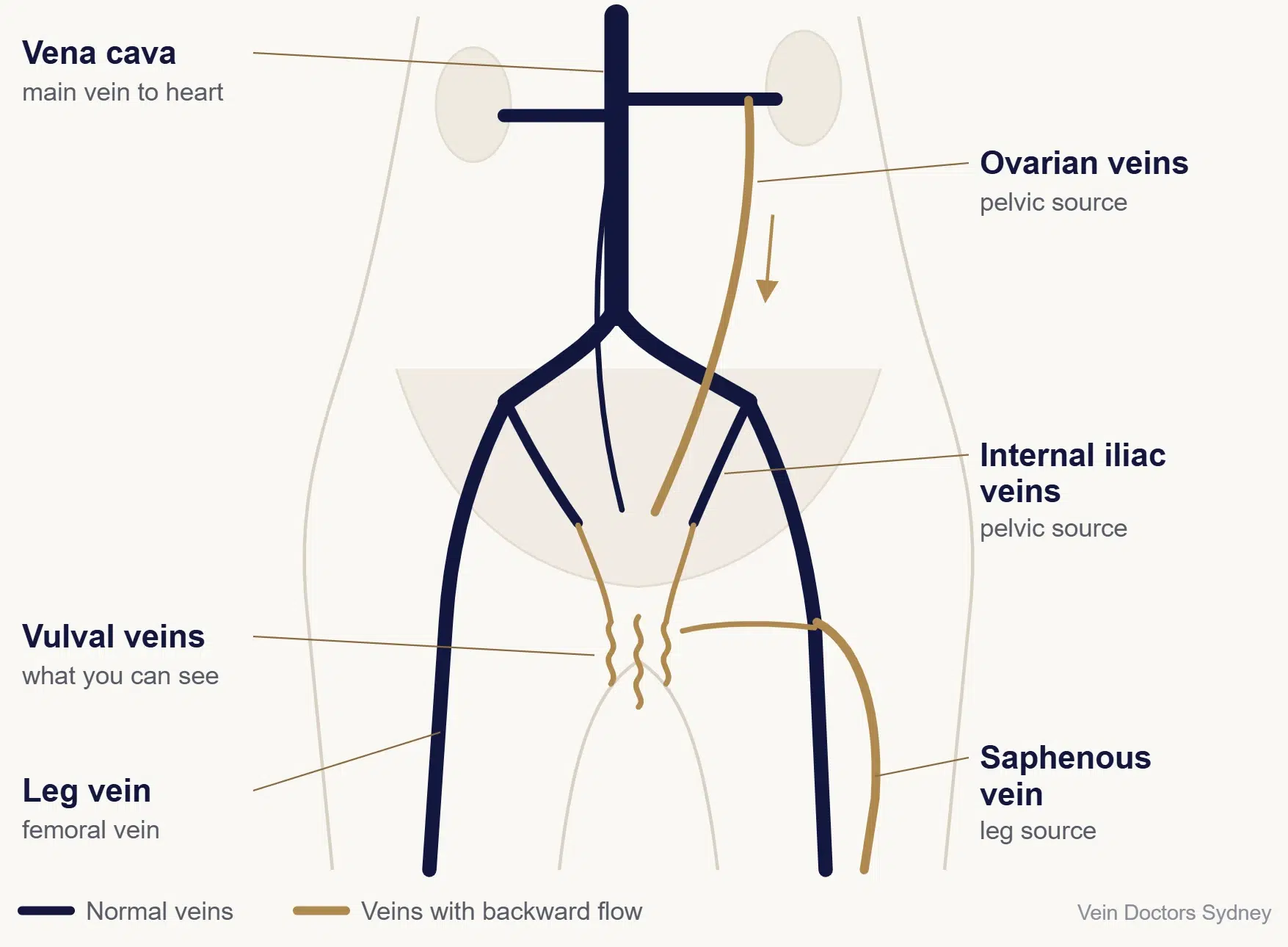
The faulty valves are usually in a pelvic vein, such as the ovarian or internal iliac veins, or in a leg vein such as the great saphenous vein. That is why the vulval veins on their own are only part of the picture.

Diagram showing vulvar varicose veins fed by faulty ovarian or internal iliac veins in the pelvis, or by the great saphenous vein in the leg
Where vulvar varicose veins come from: faulty valves in a pelvic vein or a leg vein let blood flow backwards into the vulval veins. Tap to enlarge.

Symptoms

Bulging, twisted or bluish veins on the vulva, labia or upper inner thigh
Aching, heaviness, throbbing or a feeling of pressure
Worse after standing, at the end of the day or around your period
Discomfort during or after sex
Itching or tenderness over the veins
Sometimes varicose veins on the back of the thigh or buttock as well
Pregnancy

Vulval varicose veins in pregnancy

Pregnancy is the most common time for these veins to appear, often from the second trimester. Hormones relax the vein walls, blood volume increases and the growing baby presses on the pelvic veins.

Many shrink or disappear in the months after birth, so we don’t treat them during pregnancy. If they are still there and bothering you, treatment is usually considered about 6 months after delivery.

Pregnant now? We're happy to see you for advice and simple measures to ease the discomfort, such as supportive compression garments.
Assessment

Finding where the veins come from

Treating only the visible veins tends to fail if the source is left behind. Your assessment is designed to find it.

01
Consultation
Dr McConnell talks with you about your symptoms, pregnancies and general health, and examines the area with care for your privacy.
02
Pelvic venous ultrasound
A detailed scan of the veins in your pelvis shows whether the ovarian or pelvic veins are feeding the vulval veins. It is privately billed, with a Medicare rebate.
03
Leg ultrasound if needed
If you also have leg symptoms or varicose veins, we scan your leg veins too, as a faulty great saphenous vein can feed the vulval veins.
04
Your plan and quote
You leave with a written plan and quote, and we send a letter to your GP.
Treatment

How vulvar varicosities are treated

Treatment is minimally invasive and done through a needle, so there are no surgical cuts. The order matters: the source is treated first, then the visible veins.

Some women with pelvic vein problems also have a dull, dragging pelvic ache. Read about pelvic congestion syndrome

If the veins come from the pelvis
Pelvic vein embolisation closes the faulty ovarian or pelvic veins from the inside. A thin tube is passed into the vein through a tiny nick in the skin, guided by imaging, usually as a day procedure. Any vulval veins that remain are then treated with foam sclerotherapy. About pelvic vein embolisation
If the veins come from the leg
The leg vein feeding them, often the great saphenous vein, is treated first, usually by closing it from the inside with heat or medical glue. The vulval veins are then treated with foam sclerotherapy. About varicose vein treatment
Foam sclerotherapy
A medicine mixed into a foam is injected into the vulval veins through a very fine needle, guided by ultrasound, so they close and fade. It is done in our rooms and most women need 1 to 3 sessions.
Dr Ryan McConnell, interventional radiologist
Your doctor

Dr Ryan McConnell

BMBS, FRANZCR · Interventional radiologist

Dr McConnell is an interventional radiologist and vein specialist. He treats both the leg and pelvic veins himself, so he can look after every step, from your ultrasound to embolisation and sclerotherapy.

Questions

Common questions

They are usually not dangerous, but they can be uncomfortable. Occasionally a small clot forms in one of the veins, causing a hard, tender lump. If that happens, see your GP or contact us.

Many shrink or disappear in the months after birth. If they are still there and troubling you about 6 months after delivery, an assessment is worthwhile.

Yes. They can persist after one or more pregnancies, or appear without pregnancy. This usually means the valves in a pelvic or leg vein are not working, which an ultrasound can show.

Foam sclerotherapy uses a very fine needle and most women find it only mildly uncomfortable. Pelvic vein embolisation is done with local anaesthetic and sedation. You can usually walk out the same day.

You can book before you have one, but please get a referral from your GP before your appointment. It means you can claim the Medicare rebate and we can keep your GP updated.

The first consultation is $330, with a Medicare rebate of $88.40 if you have a GP referral. The pelvic venous ultrasound is privately billed, with a Medicare rebate. Your treatment quote is given at your consultation, once we know where the veins are coming from. See our fees

Talk to us about vulval varicose veins

Book a consultation in Manly or St Leonards, or call us and we’ll find a time that suits.

Any surgical or invasive procedure carries risks. Before proceeding, you should seek a second opinion from an appropriately qualified health practitioner. Information on this website is general and isn't a substitute for advice about your own health. For other interventional radiology procedures, visit drryanmcconnell.com.au.

checkBook A
Consult